


Chapter 15.435
SIGNS
Sections:
15.435.020 Applicability and exemptions.
15.435.040 General requirements – All signs.
15.435.050 Major freestanding signs.
15.435.060 Minor freestanding signs.
15.435.080 Minor attached signs, awning signage, and umbrella signage.
15.435.085 Electronic message centers.
15.435.100 Temporary signs for events.
15.435.105 Sign permit program for portable signs on private property.
15.435.110 Signs within the public right-of-way.
15.435.120 Downtown (C-3) sign standards.
15.435.130 Original art murals.
15.435.010 Purpose.
A. The citizens of Newberg desire a clean, attractive, economically vibrant, and safe community. Well-planned and constructed signs can contribute to the community’s success by directing and informing the public about commercial and other activities, and by creating attractive commercial and other neighborhoods. On the other hand, unregulated signage can create clutter, distractions, and hazards.
B. These regulations are designed:
1. To improve, maintain and preserve Newberg as a pleasing environment so as to improve the quality of life of all residents.
2. To enhance the attractiveness of Newberg as a place to conduct business.
3. To enable the identification of places of residence and business.
4. To allow freedom of expression.
5. To reduce distractions and obstructions from signs which would adversely affect safety.
6. To reduce the hazards from improperly placed or constructed signs. [Ord. 2782 § 1 (Exh. A), 9-8-15; Ord. 2499, 11-2-98. Code 2001 § 151.590.]
15.435.020 Applicability and exemptions.
A. All signs placed or maintained anywhere within the city shall comply with the standards of this chapter, with the exception of the following:
1. Public signs.
2. Signs that are required to be placed by law and that are no more than 50 percent larger than the minimum size required by law or, if there is no minimum size specified, signs with lettering height no more than four inches.
3. Signs painted on or attached to windows that do not cover more than 50 percent of the surface of that window.
4. Signs located entirely within a building and not on a window.
5. Signs not legible from the public right-of-way.
B. If any of the signs listed above require permits under the current edition of the Oregon Structural Specialty Code, the sign shall be placed only following issuance of such permit.
C. Nothing in this chapter shall be construed to allow placement of a sign on a property without the authority of the property owner. [Ord. 2782 § 1 (Exh. A § 1), 9-8-15; Ord. 2499, 11-2-98. Code 2001 § 151.591.]
15.435.030 Permit required.
A. Except as follows, no person or entity shall place any sign within the city without first obtaining a permit from the director.
B. The following do not require sign permits, but must otherwise comply with the standards of this chapter:
3. Temporary signs.
4. Portable signs (except as stated in NMC 15.435.105).
5. Flag display (two allowed on each street frontage, except as authorized by NMC 15.435.100(C)).
6. If any of the signs listed above require permits under the current edition of the Oregon Structural Specialty Code, the sign shall be placed only following the issuance of such permit. [Ord. 2897
§ 1 (Exh. A § 1), 6-21-22; Ord. 2782 § 1 (Exh. A), 9-8-15; Ord. 2499, 11-2-98. Code 2001 § 151.592.]
Penalty: See NMC 15.05.120.
15.435.040 General requirements – All signs.
A. All signs shall comply with the standards contained in the current edition of the Oregon Structural Specialty Code. If the standards of that code and this development code conflict, this development code shall prevail. All signs shall be kept in repair and in a proper state of preservation as required under the current edition of the Oregon Structural Specialty Code.
B. No sign shall have bright or flashing lights shining on a public way that blind or impair the vision of drivers. No sign shall be constructed such that it may be confused with any traffic sign, signal or device.
C. In the C-3 and M-5 zones, animated signs are prohibited.
D. All signs shall comply with the vision clearance standards of NMC 15.410.060.
E. Signs located in the airport overlay subdistrict shall comply with the eight and visual interference restrictions of that district. [Ord. 2930 § 4 (Exh. A-3), 1-6-25; Ord. 2782 § 1 (Exh. A), 9-8-15; Ord. 2731 § 3, 10-18-10; Ord. 2565, 4-1-02; Ord. 2561, 4-1-02; Ord. 2499, 11-2-98. Code 2001 § 151.593.]
Penalty: See NMC 15.05.120.
15.435.050 Major freestanding signs.1
A. Number.
1. Residential, I, and CF Zones. One major freestanding sign is allowed on each street frontage, plus one sign for each full 600 feet of street frontage. Only one sign on each street frontage may be an animated sign.
2. Other Zones. Not more than one major freestanding sign shall be located on any one street frontage.
B. Size.
1. Residential Zones. No major freestanding sign shall be larger than 0.2 square feet per foot of street frontage, up to a maximum of 50 square feet. At least six square feet of signage will be allowed. Major freestanding signs are not allowed on lots containing only one single-family dwelling or duplex.
2. C-1 and I Zones. No major freestanding sign shall be larger than one-half square foot per foot of street frontage, up to a maximum of 100 square feet. At least 12 square feet of signage will be allowed.
3. Other Zones. No major freestanding sign shall be larger than one square foot per foot of street frontage, up to a maximum of 100 square feet. At least 40 square feet of signage will be allowed. For any lot at least 10 acres in size with at least 200 feet of frontage on a street, the one sign on that street may be up to 200 square feet total size.
C. Height and Setbacks. Freestanding signs regulated by this section are not subject to the setback requirements of NMC 15.410.010 through 15.410.070 or the projecting building features requirements of said sections. Height and setbacks of freestanding signs shall conform to the following height limitations and other requirements:
1. C-3 Zone. No major freestanding signs shall be allowed greater than six feet in height.
2. Other Zones.
a. A sign up to three feet in height is not required to be set back from any property line.
b. A sign taller than three feet and up to six feet shall be set back at least five feet from any property line.
c. A sign taller than six feet and up to eight feet shall be set back at least 10 feet from any front property line and five feet from any interior property line.
d. A sign taller than eight feet and up to 15 feet shall be set back at least 15 feet from any front property line and five feet from any interior property line.
e. A sign taller than 15 feet and up to 20 feet shall be set back at least 20 feet from the front property line and five feet from any interior property line.
f. A sign taller than 20 feet is not permitted except as provided by subsection (C)(2)(g) of this section.
g. A sign on a lot that is at least 10 acres in size in a zone other than residential, C-1, or I and that has at least 200 feet of frontage on a street may be up to 30 feet high, provided it is set back at least 20 feet from the front property line and at least 10 feet from any interior property line. [Ord. 2940 § 1 (Exhs. A-1a, A-1b), 11-17-25; Ord. 2731 § 3, 10-18-10; Ord. 2646, 6-5-06; Ord. 2565, 4-1-02; Ord. 2561, 4-1-02; Ord. 2499, 11-2-98. Code 2001 § 151.594.]
Penalty: See NMC 15.05.120.
15.435.060 Minor freestanding signs.
A. Number. Not more than two minor freestanding signs shall be located in the front yard on any one street frontage, plus one for each full 100 feet of street frontage. This number limit shall not apply to minor freestanding signs located outside a required front yard and more than 10 feet from the public right-of-way.
B. Size.
1. Residential Zones. No minor freestanding sign shall exceed three square feet in area.
2. Other Zones. No minor freestanding sign shall exceed six square feet in area.
C. Height. No minor freestanding sign shall exceed three feet in height. [Ord. 2561, 4-1-02; Ord. 2499, 11-2-98. Code 2001 § 151.595.]
Penalty: See NMC 15.05.120.
15.435.070 Major attached.
A. Number.
1. C-3 Zone. Allowed major attached signs include flat wall signs and signs that project over the sidewalk. Prohibited signs include signs on roofs, chimneys or balconies.
2. All Zones. The number of major attached signs on any building face shall not exceed one per 25 feet of building frontage of that face.
B. Size.
1. R-1’, R-2, and R-3 Zones. The total of all major attached signs on any building frontage shall not exceed 0.2 square feet for each foot of building frontage. At least six square feet of signage will be allowed up to a maximum of 50 square feet. Major attached signs are not allowed on lots containing only one single-family dwelling or duplex.
2. RP, C-1, and I Zones. The total of all major attached signs on any building frontage shall not exceed one-half square foot for each foot of building frontage. At least 12 square feet of signage will be allowed.
3. Other Zones. The total of all major attached signs on any building frontage shall not exceed one square foot for each foot of building frontage. At least 40 square feet of signage will be allowed.
C. Height.
1. C-3 Zone. Maximum mounting height for wall signs shall be 18 feet above the sidewalk, measured from the top of the sign. The top signboard of a projecting sign on a single-story building shall not be higher than the wall from which it projects. For multistory buildings, the signboard shall not be higher than the average sill height of the second-story windows. Projecting signs shall be mounted such that the distance between the lower edge of the signboard and the ground level is not less than eight feet. The distance from the building wall to the signboard shall be a maximum of six inches.
2. Other Zones. Major attached signs shall not extend above the roof line of the building they are attached to by more than eight feet, and shall not exceed the maximum height of the zone in which they are located.
D. Projections. Major attached signs may project into the required front yard no more than five feet and into the required interior yards not more than two feet; provided, that such projections are no closer than three feet to any interior lot line. For buildings in the C-3 zone, major attached signs may project up to five feet into the right-of-way, but not closer than two feet from the curb line. The lower edge of any major attached sign shall be at least eight feet above ground level. This requirement supersedes the relevant sign standards in the current edition of the Oregon Structural Specialty Code. [Ord. 2731 § 3, 10-18-10; Ord. 2561, 4-1-02; Ord. 2499, 11-2-98. Code 2001 § 151.596.]
Penalty: See NMC 15.05.120.
15.435.080 Minor attached signs, awning signage, and umbrella signage.
1. Spacing. No two minor attached signs on one building that are both visible from any one point shall be closer than 25 feet.
2. Size.
a. Residential Zones. Minor attached signs shall not exceed three square feet in area.
b. Other Zones. Minor attached signs shall not exceed six square feet in area.
3. Height. Minor attached signs shall not extend above the roof line of the building they are attached to.
4. Projections.
a. C-3 Zone. Minor attached signs may project no more than three feet into a public right-of-way, but no closer than two feet from the curb line. The lower edge of any minor attached sign shall be at least eight feet above ground level. This requirement supersedes the relevant sign standards in the current edition of the Oregon Structural Specialty Code.
b. Other Zones. The same projection is allowed as for major attached signs, NMC 15.435.070.
B. Awning Signage. Awnings are encouraged along the frontage of buildings in the C-3 district.
1. C-3 Zone. Back-lit translucent awnings are not allowed. Lettering may appear on curved surfaces, but shall be limited to the lowest 12 inches of the awning (measured vertically from the lowest edge). Freestanding letters mounted on top of the front vertical surface are also allowed, though they shall not exceed eight inches in height.
a. Other minor attached signs may be attached to or suspended from an awning or canopy, provided they are less than six square feet in size.
b. The lower edge of any awning shall be at least eight feet above ground level. This requirement supersedes the relevant sign standards in the Uniform Sign Code.
c. Signage is not allowed on any awning surfaces that are not specifically permitted in this section.
2. Other Zones. Awning signs in other zones shall be regulated as either minor or major attached signs.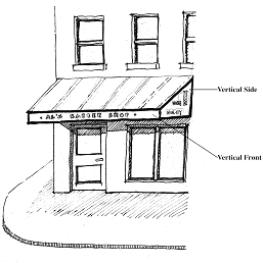
C. Umbrella Signage. Signs on umbrellas are allowed without a sign permit but are limited to the lowest 12 inches of the umbrella (measured along the umbrella surface from the lowest edge). Umbrella signs shall comply with all other municipal code requirements. [Ord. 2782 § 1 (Exh. A), 9-8-15; Ord. 2561, 4-1-02; Ord. 2499, 11-2-98. Code 2001 § 151.597.]
Penalty: See NMC 15.05.120.
15.435.085 Electronic message centers.
A. Electronic message center (EMC) signs are permitted subject to the limitations shown in the table below:
|
Zoning |
Size of EMC [1] |
Display Method |
||||
|---|---|---|---|---|---|---|
|
Extended Video Message |
||||||
|
Community Commercial and Industrial (C-2, M-1, M-2, M-3, M-4); other zones not listed |
Up to 30 sq. ft. |
Allowed |
Allowed |
Allowed |
Prohibited |
Prohibited |
|
> 30 sq. ft. up to 50 sq. ft. |
Allowed |
Allowed |
Allowed [2] or site element review |
Prohibited |
Prohibited |
|
|
> 50 sq. ft. up to 100 sq. ft. |
Allowed |
Allowed |
Site element review |
Prohibited |
Prohibited |
|
|
Craft Industrial District (M-5) |
Up to 30 sq. ft. |
Allowed |
Allowed |
Prohibited |
Prohibited |
Prohibited |
|
> 30 sq. ft. up to 100 sq. ft. |
Allowed |
Allowed |
Prohibited |
Prohibited |
Prohibited |
|
|
Central Business District (C-3) |
Up to 30 sq. ft. |
Allowed |
Prohibited |
Prohibited |
Prohibited |
Prohibited |
|
> 30 sq. ft. up to 100 sq. ft. |
Allowed |
Prohibited |
Prohibited |
Prohibited |
Prohibited |
|
|
Institutional (I), Neighborhood Commercial (C-1), and Residential-Professional (R-P) |
Up to 30 sq. ft. |
Allowed |
Allowed |
Allowed |
Prohibited |
Prohibited |
|
> 30 sq. ft. up to 50 sq. ft. |
Allowed |
Allowed |
Allowed [2] or site element review |
Prohibited |
Prohibited |
|
|
> 50 sq. ft. up to 100 sq. ft. |
Allowed |
Site element review |
Site element review |
Prohibited |
Prohibited |
|
|
All Residential Zones (Including R‑1, R-2, and R-3) [3] |
Up to 30 sq. ft. |
Allowed |
Allowed |
Allowed |
Prohibited |
Prohibited |
|
> 30 sq. ft. up to 50 sq. ft. |
Allowed [2] |
Allowed [2] |
Allowed [2] |
Prohibited |
Prohibited |
|
[1] Maximum size of EMC is limited by the maximum size of sign allowed in that zone. Therefore, EMCs of the size shown may or may not be allowed.
[2] Allowed if setback from front property line is greater than 30 feet.
[3] Must be turned off between the hours of 11:00 p.m. and 6:00 a.m.
B. Review Process for Allowed EMC. The table in subsection (A) of this section lists the zones where EMCs are allowed, based on the display method, size, and review process. EMCs that are allowed in the zone will use the standard Type I administrative review process.
C. Review process for EMCs that require site element review:
Site element review is a Type I process with a decision by the planning director.
1. Criteria. The review body must find that the sign will be compatible with surrounding uses, based on all of the following factors:
a. Proposed sign operation complies with the code.
b. Setback: at least 15 feet from the front property line.
c. Hours of operation: may be required to be turned off between the hours of 11:00 p.m. and 6:00 a.m. if sign is abutting and visible from a residential district.
d. Site landscaping is maintained and is up to code. If the site is nonconforming and cannot be brought up to code then efforts have been made to bring the site as close to code as practical.
e. Freestanding signs include three of the following design elements:
i. Includes prominent brickwork, masonry, naturally finished wood, or naturally finished metal in frame or supports.
ii. Includes neon type tube lighting on portions of the sign outside the EMC.
iii. Uses two support poles or a full-width support structure.
iv. Outline or top of the frame is predominantly nonrectangular or curved.
v. Includes landscaping around the base equal in area to the size of the sign.
vi. More than 40 percent of sign is EMC.
vii. Height is 20 percent lower than otherwise required.
viii. Setback is 20 percent greater than otherwise required.
ix. Sign will be used by two or more businesses on site. Each business must have two or more employees on site at least 15 hours per week.
2. Appeals. Appeal of the director’s decision will be to the planning commission.
D. Size Incentive. If any freestanding EMC sign includes four of the design elements in subsection (C)(1)(e) of this section, then the allowable sign area is increased by 10 percent. If any freestanding EMC sign includes five or more of the design elements in subsection (C)(1)(e) of this section, then the allowable sign area is increased by 20 percent.
E. Electronic Scoreboards. Electronic scoreboards with electronic message centers in stadiums or at sports fields are not considered signs or limited in size or display method if they are oriented inward to the playing field.
F. Sign Maintenance. All electronic message centers shall be kept in a good state of repair. Any burned out lights or LEDs shall be replaced as soon as possible.
G. Brightness. Each electronic message center shall be equipped with dimming technology that automatically varies the brightness of the electronic message display according to ambient light conditions. This standard shall only apply to signs approved after October 18, 2010. [Ord. 2930 § 4 (Exh. A-3), 1-6-25; Ord. 2731 § 1, 10-18-10. Code 2001 § 151.597.5.]
15.435.090 Portable signs.
A. Number. Not more than two portable signs may be located on any one street frontage, except temporary signs allowed per NMC 15.435.100.
B. Size.
1. Residential Zones.
a. Residential Uses. Two portable signs. Each sign not to exceed six square feet.
b. All Other Permitted Uses. Two portable signs not to exceed six square feet if located in the front yard, or 16 square feet if located elsewhere on the property.
2. Other Zones. The two portable signs may not exceed 12 square feet if located in the front yard, or 40 square feet if located elsewhere on the property.
C. Design. No portable sign shall be permanently affixed to any structure or the ground. No portable sign shall be attached to a tree, utility pole, traffic sign, street sign, or any publicly owned pole, post, wire or cable, except as authorized by the city. All signs shall be designed to be removed quickly. No portable sign shall be animated or internally illuminated. No readerboard shall be used as a portable sign, except as a temporary sign as permitted in NMC 15.435.100.
D. Location. No portable sign shall be located within the public right-of-way except as allowed under NMC 15.435.110.
E. Height. The height of a portable sign shall not exceed the maximum height of buildings in that zone. [Ord. 2897 § 1 (Exh. A § 2), 6-21-22; Ord. 2782 § 1 (Exh. A), 9-8-15; Ord. 2499, 11-2-98. Code 2001 § 151.598.]
Penalty: See NMC 15.05.120.
15.435.100 Temporary signs for events.
In addition to the portable signs otherwise permitted in this code, a lot may contain temporary signs in excess of the number and size allowed by NMC 15.435.090 during events as listed below. Pennants, streamers, and inflatable objects may be used during these events.
A. Grand Opening Event. A grand opening is an event of up to 30 days in duration within 30 days of issuance of a certificate of occupancy for a new or remodeled structure, or within 30 days of change of business or ownership. No lot may have more than one grand opening event per calendar year. The applicant shall notify the city in writing of the beginning and ending dates prior to the grand opening event. If there are no freestanding signs on a frontage after the grand opening event, one of the temporary signs may remain on the property for the 60 days immediately after the end of the grand opening event. A temporary electronic message center may be used during a grand opening event. An unlimited number of temporary signs are allowed during a grand opening event.
B. Other Events. A lot may have two other events per calendar year. The events may not be more than eight consecutive days in duration, nor less than 30 days apart. A temporary electronic message center may be used during the event. An unlimited number of temporary signs are allowed during the event. The applicant shall notify the city in writing of the beginning and ending dates prior to the other event.
C. Flags. An unlimited number of flags are permitted on Memorial Day, Presidents’ Day, Independence Day, Veterans Day, Labor Day, Flag Day, Peace Officers Day, the Friday of the Camellia Festival, the Friday of the Old Fashioned Festival, on days when flags are normally flown at half-mast, or on any festival day designated by the Newberg city council. [Ord. 2897 § 1 (Exh. A § 3), 6-21-22; Ord. 2782 § 1 (Exh. A), 9-8-15; Ord. 2731 § 3, 10-18-10; Ord. 2499, 11-2-98. Code 2001 § 151.599.]
Penalty: See NMC 15.05.120.
15.435.105 Sign permit program for portable signs on private property.
A. Purpose. The purpose of the sign permit program is to allow additional temporary and portable signage for properties within the C-2, C-3, and institutional zones than is otherwise allowed by the municipal code. The goal of the permit program is to allow additional signage on private property with a coordinated appearance.
B. Process. Applications for a permit under the sign permit program will be reviewed under a Type I process. Signage allowed under the permit must be well-maintained both physically and operationally. Signage under the permit that is found to not be well-maintained may result in the permit being revoked. Permits may be obtained for up to one year. Permits may be renewed, as long as they continue to meet the permit requirements. Only a property owner or their designee is allowed to obtain a permit under the sign permit program. A property owner is allowed one sign permit per property.
C. Criteria. The following criteria must be met for permit approval under the sign permit program:
1. Number of signs per property: one per 100 feet of street frontage in C-2 zone; one per 15 feet of street frontage, with a maximum of four signs total within the C-3 zone; and one per 100 feet of street frontage within the institutional zone. If more than one business is located on a property, at least one sign per business is allowed, as long as the business occupies a discrete space and possesses its own business license.
2. Size and Location of Signs. Maximum total signage for all temporary and portable signs under a sign permit shall be one square foot per one foot of street frontage. Maximum size allowed for any specific sign will be based on the location of the sign, up to a maximum of 40 square feet. The farther the distance a sign is from the front property line, the greater size that will be allowed for a specific sign. Maximum size for signage within the first 10 feet from the property line is 10 square feet. For every additional 10 feet from the property line, the maximum square footage for a sign will be an additional 10 square feet larger. Example: if a sign is between the front property line and 10 feet from the property line, then maximum sign size is 10 square feet; if a sign is between 10 feet and 20 feet from the property line, then the maximum sign size is 20 square feet in size, and so on.
3. Coordinated Appearance. Every sign approved under an individual sign permit must have a cohesive, coordinated appearance. Signs must meet three of the following five criteria: similar size, colors, shape, materials, and/or font. [Ord. 2782 § 1 (Exh. A), 9-8-15.]
15.435.110 Signs within the public right-of-way.
A. Public signs are allowed in the public right-of-way as allowed by the governmental agency responsible for the right-of-way.
B. Temporary and/or portable signs for other than traffic control and motorist advisories are not allowed within state highway right-of-way administered by the Oregon Department of Transportation except on resolute highways. In 2015, the resolute highways in Newberg were: on First Street from Harrison Street to River Street, on Main Street from First Street to Illinois Street, and on College Street from First Street to Vermilion Street. On a resolute highway, the city manages the portion of the right-of-way behind the curb and can permit portable signs on the sidewalk. Portable and/or temporary signs are not allowed by ODOT on Hancock Street except within the College Street or Main Street rights-of-way. Portable and/or temporary signs are not allowed within county road right-of-way administered by Yamhill County.
C. For lots in the C-3, C-4 and M-5 zones, the two allowed portable signs per street frontage may be located, without permit, in the public right-of-way fronting that lot except as stated in subsection (B) of this section, provided they meet the following standards:
1. The signs may not be less than two feet nor more than four feet high. The signs must also conform to NMC 15.410.060 if they are within the clear vision zone.
2. The signs may not be located within the vehicular path.
3. If located on a sidewalk, the signs must leave a clear access path at least five feet wide measured horizontally across the main part of the sidewalk and may not be located on an ADA ramp.
4. If the signs are located adjacent to a striped on-street parking area, the signs must be located adjacent to the stripe.
5. The signs may not be located within three feet of a fire hydrant.
6. The sign owner must have the signs removed during hours when the business being advertised is closed.
7. The person placing the signs in the right-of-way must obtain written permission from the owner, or their designee, of the property abutting the right-of-way for any sign, other than a public sign, that is placed within that right-of-way fronting the property owner’s lot. The written permission must be presentable to code enforcement or their designee promptly upon request.
8. If more signs than are allowed by this code are located in the right-of-way fronting one lot, all signs may be forfeited as per subsection (F) of this section.
9. Portable and/or temporary signs are not allowed by ODOT on sidewalks along Hancock Street except within the College Street and Main Street rights-of-way.
D. For lots in other zones, two portable or minor freestanding signs per street frontage may be allowed in the public right-of-way except as stated in subsection (B) of this section, provided:
1. The standards of subsection (C) of this section shall be met with the exception of subsection (C)(6) of this section.
2. Any sign installed or placed in the public right-of-way within these zones not in conformance with subsection (C)(7) of this section shall be forfeited to the owner of the property abutting the right-of-way and is subject to confiscation by said owner.
3. Portable and/or temporary signs are not allowed in the right-of-way along Highway 99W, Highway 240 or Highway 219 except as noted in subsection (B) of this section.
E. No other signs shall be placed within the public right-of-way except as specifically permitted by this code.
F. Any sign installed or placed in the public right-of-way, except in conformance with the requirements of this code, shall be forfeited to the city and subject to confiscation by city employees. In addition to other remedies hereunder, the city shall have the right to recover from the owner or person placing such a sign the full costs of removal and disposal of such sign. Identifying information on the sign shall be prima facie evidence that the individual or entity so identified is the violator. [Ord. 2930 § 4 (Exh. A-3), 1-6-25; Ord. 2929 § 1 (Exh. A-1 § 2), 9-3-24; Ord. 2897 § 1 (Exh. A § 4), 6-21-22; Ord. 2782 § 1 (Exh. A), 9-8-15; Ord. 2706 § 1 (Exh. A(2)), 10-6-08; Ord. 2564, 4-15-02; Ord. 2499, 11-2-98. Code 2001 § 151.600.]
Penalty: See NMC 15.05.120.
15.435.120 Downtown (C-3) sign standards.
A. Purpose. Newberg’s downtown is the heart of the community. A variety of early 20th century commercial buildings define its character. The community’s vision is for this area to be a lively, customer- and pedestrian-friendly district with a variety of successful businesses. Competition from other retail areas requires this area to have an identity and look that are distinct and attractive. Capturing the historic and unique feel of the downtown through sign design standards will aid in its vitality. These standards are intended to promote the economic vitality of downtown by promoting attractive, historically themed, and pedestrian-oriented signage.
B. Design Standards. In addition to meeting other standards within this code, any major attached or freestanding sign within the C-3 district shall score at least 10 points using the following scale. Where more than one sign exists on a frontage, the total score shall be the average score for all signs on that frontage.
|
Points Possible |
Element |
|---|---|
|
|
Sign Type |
|
4 |
The sign is attached to a mounting bracket and allowed to swing freely. |
|
4 |
The sign is on an awning and meets the standards in NMC 15.435.080. |
|
3 |
The sign is a fin sign extending at least two feet from the building surface. |
|
3 |
The sign primarily includes raised or engraved individual letters or graphics on a background wall. |
|
2 |
The sign is freestanding and less than six feet high. |
|
|
Sign Material |
|
4 |
The sign is sandblasted or carved wood. |
|
4 |
The sign includes natural finished wood in the frame, background or lettering (plywood excluded). |
|
4 |
The sign includes a frame, background or lettering in aluminum, copper or brass in natural finishes. |
|
2 |
The sign is on an opaque fabric awning made of cotton-based canvas or woven acrylic and includes free-hanging trim or vertical front. |
|
2 |
The sign incorporates decorative wrought iron. |
|
|
Sign Face |
|
4 |
The outline of the sign frame (or the letters and graphics if no frame) is predominantly curved or nonrectangular. |
|
3 |
All colors on the sign are low intensity, such as muted earth tones. Bright, fluorescent, or neon colors are excluded. |
|
2 |
The most prominent lettering on the sign, such as the business’ name, uses a serif or cursive font. |
|
2 |
At least 15 percent of the sign area is a landscape, nature, or similar art scene. |
|
|
Lighting |
|
2 |
The sign uses neon tube lighting for letters or graphics. |
|
minus 2 |
The sign uses internal illumination with greater than 30 percent transparent or light-colored face. |
|
minus 2 |
|
|
minus 4 |
The sign uses blinking, flashing, or chasing lights. |
|
|
Sign Size |
|
1 point per 20 percent reduction |
For major attached signage, one point for each full 20 percent reduction in the total sign area allowed on that building frontage. For major freestanding signage, one point for each full 20 percent reduction in the total area allowed for that sign. |
C. Bonus Provisions.
1. Notwithstanding other provisions of this code, a proposed sign in the C-3 district that scores in excess of 10 points using the above scale may be larger than the maximum allowable size of a sign otherwise allowed by this code. An increase of 10 percent of the maximum size is allowed for each point scored over 10 points.
2. The director may refund 25 percent of sign design review fees paid for any sign scoring in excess of 15 points on the scale. [Ord. 2561, 4-1-02. Code 2001 § 151.601.]
15.435.130 Original art murals.
A. Purpose. The purpose of this section and the policy of the City of Newberg is to permit and encourage original art murals on a content-neutral basis on certain terms and conditions. Original art murals comprise a unique medium of expression which serves the public interest. Original art murals have purposes distinct from other types of signs and confer different benefits. Such purposes and benefits include: improved aesthetics; avenues for original artistic expression; public access to original works of art; community participation in the creation of original works of art; community building through the presence of and identification with original works of art; and a reduction in the incidence of graffiti and other crime. Murals can increase community identity and foster a sense of place and enclosure if they are located at heights and scales visible to pedestrians, are retained for longer periods of time and include a neighborhood process for discussion.
B. Allowed and Prohibited Original Art Murals.
1. Allowed Original Art Murals. Original art murals that meet all of the following criteria and which are not prohibited will be allowed upon satisfaction of the applicable permit requirements:
a. The mural shall remain in place, without alterations, for a period of three years, except in limited circumstances to be specified in this code. The applicant shall certify in the permit application that the applicant agrees to maintain the mural in place for a period of three years without alteration. The applicant can remove the mural at any time, but may be prevented by the terms of this code from replacing the mural until the three-year period after the date of the mural permit approval is completed.
b. The mural shall not extend more than six inches from the plane of the wall upon which it is tiled or painted or to which it is affixed. Murals with projecting features may also require a building permit and structural review; murals which consist only of paint on a wall will not require a building permit.
c. Location of mural on the building:
i. In the C-3 central business district zone murals are permitted only on walls that do not face First Street or Hancock Street.
ii. If the site abuts the Newberg-Dundee bypass (Oregon Highway 18), then murals are permitted only on walls that do not face the bypass until January 1, 2017.
iii. In all other areas murals are permitted on any wall of a building.
d. Qualifying wall surfaces for murals:
i. Murals are permitted only on the flat planes of walls.
ii. Murals are permitted only on walls that have not had a specific material, color or texture reviewed and approved through design review, unless a new design review has allowed the mural to change the originally approved color, texture or material.
iii. Mural areas will not be painted on or obscure architectural features such as windows, doors, pilasters, cornices or other building recessed or projecting features.
iv. The building on which the mural will be painted must have either a certificate of occupancy or be legally occupied, and the floor area of the building must exceed the square footage of the mural.
e. Number of mural permits per building wall: Only one mural permit may be obtained per wall.
f. Original art murals are allowed in commercial, industrial and institutional zones. In residential zones, original art murals are allowed only on assembly, school uses and public buildings.
2. Prohibited Murals. The following are prohibited:
a. Murals for which compensation is given or received for the display of the mural or for the right to place the mural on another’s property. The applicant shall certify in the permit application that no compensation will be given or received for the display of the mural or the right to place the mural on the property.
b. Murals which would result in a property becoming out of compliance with the provisions of the development code, or land use conditions of approval for the development on which the mural is to be located.
C. Relationship of Permitted Original Art Mural to Other Regulations. The exemption from other sign code restrictions applies only to original art murals for which a permit has been obtained under this section and any adopted administrative processes. Issuance of an original art mural permit does not exempt the permittee from complying with any other applicable requirements of the Newberg Municipal Code, including but not limited to NMC Titles 14 and 15.
D. Exceptions to this Section. Variances or adjustments to the regulations of this section are prohibited.
E. Alterations to or Removal of a Permitted Mural.
1. Permitted murals may only be altered within the first three years of the date of completion under the following circumstances:
a. The building on which the mural is located has an ownership change; or
b. The building or property is substantially remodeled, altered, or damaged in a way that precludes continuance of the mural.
i. Alterations are allowed per above but must be approved by obtaining a new permit.
ii. Alterations for reasons other than the circumstances described above are not permitted and are considered a violation of the mural permit approval. The mural would be required to be removed and this would preclude approval of a new mural permit at the site for a three-year period after the date of the original mural permit completion.
2. Permitted murals may be removed at any time. Removal of the permitted mural for reasons other than the circumstances described in subsection (E)(1) of this section, however, precludes approval of a new mural permit at the site for a three-year period after the date of the original mural permit completion.
3. Permitted murals may be altered after the first three years of the date of completion through approval of a new mural permit.
4. Permitted murals may be removed for any reason after the first three years of the date of completion. Replacing the mural would require a new mural permit.
5. Permitted murals must be kept in good state of repair and in good condition.
F. Establishment of a Neighborhood Involvement Process and Community Arts Review for Permits.
1. Purpose. The purpose of the neighborhood involvement process and community arts review is to encourage community discussion and participation in the creation of original works of art that will be highly visible in the community. It is intended to enhance the final art product by providing information on the physical, social, and historical context within which the mural will be placed, and to provide creative suggestions on how the mural can contribute to the overall beauty and attractiveness of the community.
2. Neighborhood Involvement Process. The applicant for an original art mural permit is required to provide notice of and to hold a neighborhood meeting on the mural proposal at which interested members of the public may review and comment upon the proposed mural. A notice sign must be posted at the site of the proposed mural at least 14 days before the neighborhood meeting. A notice of the meeting must be mailed to all property owners within 500 feet of the site at least 14 days before the neighborhood meeting, in the same manner as a Type II process. After the meeting, the applicant shall submit a letter to the city summarizing the public comments and stating how they have addressed the recommendations from the public.
3. Community Arts Organization Review. The director shall establish a community arts review process requiring an applicant for an original arts mural permit to submit the application to a designated community arts organization for review. The community arts organization shall be designated by the director, and shall be: (a) a nonprofit; (b) not associated with the mural artist, property owner or tenant; and (c) must have at least three members. The community arts organization shall review the application, consider the artistic merit of the proposed mural, and provide a formal written recommendation to the applicant and the director regarding the proposed mural within 14 days of receiving the application. The applicant shall submit a letter to the city stating how they have addressed the recommendations from the community arts organization.
4. No original art mural permit shall be issued until the applicant certifies that he or she has completed the required neighborhood involvement process and community arts organization review. The applicant should carefully consider the recommendations from the public and the community arts organization, but they are not obligated to change the design based on these recommendations. This is a process requirement only and in no event will an original art mural permit be granted or denied based upon the content of the mural.
G. Administrative Process. The director is authorized to create an application form and other administrative procedures necessary to administer this code section. A permit fee will be set by council resolution.
H. Violations and Enforcement.
1. Violations. It is unlawful to violate any provision of this section, any administrative rules adopted by the director pursuant to this section, or any representations made or conditions or criteria agreed to in an original art mural permit application. This applies to any applicant for an original art mural permit, to the proprietor of a use or development on which a permitted original art mural is located, or to the owner of the land on which the permitted original art mural is located. For the ease of reference in this section, all of these persons are referred to by the term “operator.”
2. Notice of Violations. The director must give written notice of any violation to the operator. Failure of the operator to receive the notice of the violation does not invalidate any enforcement actions taken by the city.
3. Penalty. Violation of any provision of this code is a city Class 2 civil infraction and shall be processed in accordance with the uniform civil infraction procedure ordinance, Chapter 2.30 NMC. Each day of a continuing violation constitutes a separate violation. [Ord. 2847 § 1 (Exh. A). 8-19-19; Ord. 2765 § 1 (Exh. A § 1), 11-4-13.]
City of Newberg follows all federal and state mandated ADA guidelines, see United States Access Board Public Right-of-Way Accessibility Guidelines below: https://www.access-board.gov/prowag/