


Chapter 15.440
OFF-STREET PARKING, BICYCLE PARKING, AND PRIVATE WALKWAYS
Sections:
Article I. Off-Street Parking Requirements
15.440.010 Required off-street parking.
15.440.020 Parking area and service drive design.
15.440.030 Parking spaces required.
15.440.040 Parking requirements for uses not specified.
15.440.045 Parking study option.
15.440.050 Common facilities for mixed uses.
15.440.060 Parking area and service drive improvements.
15.440.070 Parking tables and diagrams.
15.440.075 Residential garage standards.
15.440.080 Off-street loading.
Article II. Bicycle Parking
15.440.100 Facility requirements.
Article III. Private Walkways
15.440.140 Private walkway design.
Article I. Off-Street Parking Requirements
15.440.010 Required off-street parking.
A. Off-street parking shall be provided on the lot or development site for all R-1, C-1, M-1, M-2 and M-3 zones. In all other zones, the required parking shall be on the lot or development site or within 400 feet of the lot or development site which the parking is required to serve. All required parking must be under the same ownership as the lot or development site served, except through special covenant agreements as approved by the city attorney, which bind the parking to the lot or development site.
B. Off-street parking is required pursuant to NMC 15.440.030 in the C-2 district.
C. Off-street parking is not required in the C-3 or M-5 district, except for:
1. Dwelling units meeting the requirements noted in NMC 15.305.020.
2. New development which is either immediately adjacent to a residential district or separated by nothing but an alley.
D. Within the C-4 district, the minimum number of required off-street parking spaces shall be 50 percent of the number required by NMC 15.440.030, except that no reduction is permitted for residential uses.
E. All commercial, office, or industrial developments that have more than 20 off-street parking spaces and that have designated employee parking must provide at least one preferential carpool/vanpool parking space. The preferential carpool/vanpool parking space(s) must be located close to a building entrance.
F. Residential garages meeting the requirements of NMC 15.440.075 shall be counted towards required off-street parking spaces for residential uses. [Ord. 2933 § 1 (Exhs. A-1a, A-1b), 2-18-25; Ord. 2930 § 4 (Exh. A-3), 1-6-25; Ord. 2889 § 2 (Exh. B § 35), 12-6-21; Ord. 2862 § 1 (Exh. A § 2), 6-15-20; Ord. 2851 § 1 (Exh. A § 2), 1-21-20; Ord. 2810 § 2 (Exhs. B, C), 12-19-16; Ord. 2763 § 1 (Exh. A § 15), 9-16-13; Ord. 2564, 4-15-02; Ord. 2561, 4-1-02; Ord. 2451, 12-2-96. Code 2001 § 151.610.]
Penalty: See NMC 15.05.120.
15.440.020 Parking area and service drive design.
A. All public or private parking areas, parking spaces, or garages shall be designed, laid out and constructed in accordance with the minimum standards as set forth in NMC 15.440.070.
B. Groups of three or more parking spaces, except those in conjunction with a single-family detached dwelling, duplex dwelling, triplex dwelling, quadplex dwelling, townhouse dwelling or cottage cluster project on a single lot, shall be served by a service drive so that no backward movement or other maneuvering of a vehicle within a street, other than an alley, will be required. Service drives shall be designed and constructed to facilitate the flow of traffic, provide maximum safety in traffic access and egress and maximum safety of pedestrian and vehicular traffic on the site, but in no case shall two-way and one-way service drives be less than 20 feet and 12 feet, respectively. Service drives shall be improved in accordance with the minimum standards as set forth in NMC 15.440.060.
C. Gates. A private drive or private street serving as primary access to more than one dwelling unit shall not be gated to limit access, except as approved by variance.
D. In the AI airport industrial district and AR airport residential district, taxiways may be used as part of the service drive design where an overall site plan is submitted that shows how the circulation of aircraft and vehicles are safely accommodated, where security fences are located, if required, and is approved by the fire marshal, planning director, and public works director. The following submittal must be made:
1. A drawing of the area to be developed, including the probable location, height, and description of structures to be constructed; the location and description of a security fence or gate to secure the aircraft operations areas of off-airport property from the other nonsecured pedestrian/auto/truck areas of on-airport property; the proposed location of the proposed taxiway access in accordance with FAA specifications (refer to Federal Aviation Administration Advisory Circular No. 150/5300-13 regarding airport design, and AC/5370-10B regarding construction standards for specifications that should be used as a guideline); and the identification of the vehicular traffic pattern area clearly separated from aircraft traffic. Once specific buildings have been designed, FAA Form 7460-1, Notice of Proposed Construction or Alteration, must be submitted to the City of Newberg, the private airport owner, and the FAA for airspace review. [Ord. 2889 § 2 (Exh. B § 36), 12-6-21; Ord. 2880 § 2 (Exh. B § 44), 6-7-21; Ord. 2670, 5-7-07; Ord. 2647, 6-5-06; Ord. 2451, 12-2-96. Code 2001 § 151.611.]
Penalty: See NMC 15.05.120.
15.440.030 Parking spaces required.1
A. The minimum number of parking spaces required and maximum number of parking spaces allowed shall be calculated pursuant to Table 15.440.030(A) or with a parking study pursuant to NMC 15.440.045.
1. In calculations of the minimum number of required parking spaces that result in a fraction, the minimum number shall be rounded down for any fraction that is less than half of a whole number and rounded up for any fraction that is equal to or greater than a half of a whole number.
2. In calculations of the maximum number of required parking spaces that result in a fraction, the maximum number allowed shall be rounded up for any fraction of a whole number.
B. In any zoning district the maximum parking spaces allowed shall be regulated by the use type in Table 15.440.030(A), except when determined with a parking study pursuant to NMC 15.440.045.
C. There is no parking minimum or maximum where parking is the sole use of a lot and such parking is not provided to meet the parking requirement of any other use.
|
|
|
Maximum Parking Spaces Allowed*** |
|
|
|---|---|---|---|---|
|
Minimum Parking Spaces Required |
Rate and Units |
|||
|
Residential Types |
||||
|
Studio or one-bedroom unit |
1 |
1.2 |
1.5 |
Per dwelling unit |
|
Two-bedroom unit |
1.5 |
1.8 |
2.25 |
Per dwelling unit |
|
Three- and four-bedroom units |
2 |
2.4 |
3 |
Per dwelling unit |
|
Five- or more bedroom unit |
0.75 |
0.9 |
1.13 |
Spaces per bedroom |
|
Parking Requirement Modifiers for Multifamily Residential Developments |
||||
|
• Unassigned spaces |
If a development is required to have more than 10 spaces on a lot, then it must provide some unassigned spaces. At least 15 percent of the total required parking spaces must be unassigned and be located for convenient use by all occupants of the development. The location shall be approved by the director. |
|||
|
• Visitor spaces |
If a development is required to have more than 10 spaces on a lot, then it must provide at least 0.2 visitor spaces per dwelling unit. |
|||
|
• On-street parking credit |
On-street parking spaces may be counted toward the minimum number of parking credit required spaces for developments required to have more than 10 spaces on a lot. The on-street spaces must be directly adjoining and on the same side of the street as the subject property, must be legal spaces that meet all city standards, and cannot be counted if they could be removed by planned future street widening or a bike lane on the street. |
|||
|
• Available transit service |
At the review body’s discretion, affordable housing projects may reduce the required off-street parking by 10 percent if there is an adequate continuous pedestrian route no more than 1,500 feet in length from the development to transit service with an average of less than one hour regular service intervals during commuting periods or where the development provides its own transit. A developer may qualify for this parking reduction if improvements on a proposed pedestrian route are made by the developer, thereby rendering it an adequate continuous route. |
|||
|
Dwelling, commercial neighborhood district (C-1) |
1 |
See dwelling types, below |
See dwelling types, below |
For each dwelling unit |
|
2 |
None |
None |
For each dwelling unit on a single lot |
|
|
1 |
None |
None |
For each dwelling unit |
|
|
Dwelling, triplex |
1 Except that conversion of a detached single- family dwelling to a triplex dwelling shall not be subject to this requirement |
None |
None |
For each dwelling unit |
|
Dwelling, quadplex |
1 Except that conversion of a detached single- family dwelling to a quadplex dwelling shall not be subject to this requirement |
None |
None |
For each dwelling unit |
|
Dwelling, townhouse |
1 |
None |
None |
For each dwelling unit |
|
Dwelling, cottage |
1 |
None |
None |
For each dwelling unit |
|
Dwelling, live/work |
1 |
1.2 |
1.5 |
For each dwelling unit |
|
Fraternities, sororities, cooperatives and dormitories |
1 |
1.2 |
1.5 |
For each three occupants for which sleeping facilities are provided |
|
1 |
1.2 |
1.5 |
For each guest room |
|
|
Rooming or boarding houses |
1 |
1.2 |
1.5 |
For each guest room |
|
1 |
1.2 |
1.5 |
Spaces per 3 beds or actual parking needs as demonstrated through a parking analysis |
|
|
1 |
None |
None |
For every two bedrooms. See NMC 15.445.330(A). |
|
|
Institutional Types |
||||
|
Churches, clubs, lodges |
1 |
1.2 |
1.5 |
Spaces for every 4 fixed seats or every 8 feet of bench length or every 28 sq. ft. where no permanent seats or benches are maintained – in main auditorium (sanctuary or place of worship) |
|
Continuing care retirement community not including nursing care |
1 |
1.2 |
1.5 |
Space per living unit |
|
Day care facility |
1 |
1.2 |
1.5 |
Spaces per employee |
|
|
1 |
1.2 |
1.5 |
Plus spaces per 10 children/adults |
|
No off-street parking other than for the required dwelling. Maximum number of spaces allowed is the same as the maximum number allowed for the required dwelling, if any. |
||||
|
Hospitals (including accessory retail wholly contained within a hospital building) |
2 |
2.4 |
3 |
Spaces for each 1,000 gross sq. ft. |
|
Libraries, museums, art galleries |
1 |
1.2 |
1.5 |
Spaces for each 250 sq. ft. of gross floor area |
|
Medical/dental offices and laboratories |
3.5 |
4.2 |
5.25 |
Spaces for each 1,000 gross sq. ft. |
|
Nursing homes, homes for the aged, group care homes, asylums, etc. |
1 |
1.2 |
1.5 |
Spaces for each 3 beds |
|
Schools, colleges – “commuter” type |
1 |
1.2 |
1.5 |
Spaces for every full-time equivalent student Plus half of the requirements for accessory buildings, (i.e., 1.E* and 3.G(1)**) |
|
Schools, colleges – “resident” type |
1 |
1.2 |
1.5 |
Spaces for every 3 full-time equivalent students Plus half of the requirements for accessory buildings, (i.e., 1.E* and 3.G(1)**) |
|
Schools, elementary or junior high |
1.5 |
1.8 |
2.25 |
Spaces for each teaching station Plus 4 for every classroom, or 1 for every 42 sq. ft. of seating area where there are no fixed seats in an auditorium or assembly area |
|
Schools, high schools |
1.5 |
1.8 |
2.25 |
Spaces for each teaching station. Plus 8 for every classroom, or 1 for every 28 sq. ft. of seating area where there are no fixed seats in an auditorium or assembly area |
|
Schools, colleges – commercial or business |
1 |
1.2 |
1.5 |
Spaces for every 3 classroom seats. Plus half of the requirements for accessory buildings, i.e., 1.-E* and 3.-G(1)**) |
|
Welfare or correctional institutions |
1 |
1.2 |
1.5 |
Spaces for each 5 beds |
|
Commercial Types |
||||
|
Barber and beauty shops |
1 |
1.2 |
1.5 |
Spaces for each 75 sq. ft. of gross floor area |
|
Bowling alleys |
6 for each bowling lane |
7.2 |
9 |
Spaces for each bowling lane |
|
Establishments or enterprises of a recreational or an entertainment nature: |
||||
|
Establishments for the sale and consumption on the premises of food and beverages with a drive-up window |
1 |
1.2 |
1.5 |
Spaces for each 75 sq. ft. of gross floor area |
|
Establishments for the sale and consumption on the premises of food and beverages without a drive-up window |
1 |
1.2 |
1.5 |
Spaces for each 100 sq. ft. of gross floor area |
|
Participating type, e.g., skating rinks, dance halls |
1 |
1.2 |
1.5 |
Spaces for each 75 sq. ft. of gross floor area |
|
Spectator type, e.g., auditoriums, assembly halls, theaters, stadiums, places of public assembly |
1 |
1.2 |
1.5 |
Spaces for each 4 seats |
|
Office buildings, business and professional offices |
1 |
1.2 |
1.5 |
Spaces for every 400 sq. ft. of gross floor area |
|
Pharmacies |
1 |
1.2 |
1.5 |
Spaces for each 150 sq. ft. of gross floor area |
|
Retail establishments, except as otherwise specified herein |
1 |
1.2 |
1.5 |
Spaces for each 300 sq. ft. of gross floor area |
|
Retail stores handling bulky merchandise, household furniture, or appliance repair |
1 |
1.2 |
1.5 |
Spaces for each 600 sq. ft. of gross floor area |
|
Industrial Types |
||||
|
Except as specifically mentioned herein, industrial uses listed as permitted in the M districts: M-1, M-2, M-3, M-4, and M-5 |
1 |
1.2 |
1.5 |
Spaces for each 500 sq. ft. of gross floor area |
|
Aircraft storage hangars up to 3,600 sq. ft. each enclosed hangar area |
None (parking occurs in hangar) |
None (parking shall occur in hangar) |
– |
|
|
Aircraft storage hangars over 3,600 sq. ft. each enclosed hangar area |
1 |
1.2 |
1.5 |
Spaces for every 700 sq. ft. of hangar area over 3,600 sq. ft. |
|
Aircraft hangars intended for repair and maintenance operations |
1 |
1.2 |
1.5 |
Spaces for each 5,000 sq. ft. of hangar |
|
|
1 |
1.2 |
1.5 |
Plus spaces for each 500 sq. ft. of shop area, |
|
|
1 |
1.2 |
1.5 |
Plus spaces for each 400 sq. ft. of office area |
|
Laboratories and research facilities |
1 |
1.2 |
1.5 |
Spaces for each 300 sq. ft. of gross floor area |
|
Machinery or equipment |
1 |
1.2 |
1.5 |
Spaces for each 400 sq. ft. of gross sales floor area |
|
Wholesale and storage operations |
1 |
1.2 |
1.5 |
Spaces for each 700 sq. ft. of gross floor area |
Notes:
* “1-E” refers to fraternities, sororities, cooperatives and dormitories that require one parking space for each three occupants for whom sleeping facilities are provided.
** “3.-G(1)” refers to establishments or enterprises of a recreational or an entertainment nature (spectator type, e.g., auditoriums, assembly halls, theaters, stadiums, places of public assembly) that require one parking space for each four seats.
*** May be calculated by a factor determined according to a parking analysis.
[Ord. 2940 § 1 (Exhs. A-1a, A-1b), 11-17-25; Ord. 2935 § 1 (Exh. A-1), 2025; Ord. 2933 § 1 (Exhs. A-1a, A-1b), 2-18-25; Ord. 2930 § 4 (Exh. A-3), 1-6-25; Ord. 2928 § 1 (Exh. A-1 § 4), 9-3-24; Ord. 2889 § 2 (Exh. B § 37), 12-6-21; Ord. 2880 § 2 (Exh. B § 45), 6-7-21; Ord. 2862 § 1 (Exh. A § 2), 6-15-20; Ord. 2763 § 1 (Exh. A § 16), 9-16-13; Ord. 27302 § 1 (Exh. A (13)), 10-18-10; Ord. 2720 § 1(19), 11-2-09; Ord. 2710 § 1, 3-2-09; Ord. 2647, 6-5-06; Ord. 2550, 5-21-01; Ord. 2451, 12-2-96. Code 2001 § 151.612.]
Penalty: See NMC 15.05.120.
15.440.040 Parking requirements for uses not specified.
The parking space requirements for buildings and uses not set forth herein shall be determined by the director through a Type I procedure based upon the requirements for the most comparable building or use specified herein, or with a parking study through the Type II procedure pursuant to NMC 15.440.045. [Ord. 2933 § 1 (Exhs. A-1a, A-1b), 2-18-25; Ord. 2451, 12-2-96. Code 2001 § 151.613.]
15.440.045 Parking study option.
Required parking spaces may be determined with a parking study approved by the director through a Type II procedure as an alternative to complying with the minimum and maximum number of parking spaces in Table 15.440.030(A). If the applicant elects to use a parking study, the parking study shall comply with the following:
A. The total number of parking spaces required shall equal the number of spaces determined to be necessary to accommodate the typical daily parking demand generated by the business or development use(s). “Typical daily parking demand” means the number of parking spaces required during the hours for the normal operation of the use or uses. The parking study shall be conducted by a registered traffic engineer or other qualified professional as determined by the director.
B. The parking study shall consider relevant references, guides, and factors that aid in the average peak parking demand determination. Such references, guides, and factors may include, but are not limited to:
1. The factors and considerations recommended by the Institute of Traffic Engineers (ITE) industry standards or comparable source approved by the director.
2. Availability and projected use of alternative transportation modes such as car share services, carpooling, bicycle, pedestrian, transit, and other modes.
3. Parking demands at similar types of facilities, in similar types of locations, either within the city or elsewhere.
C. Notwithstanding any other provision of this code to the contrary, the minimum number of parking spaces determined to be necessary pursuant to this subsection shall not be eligible for reduction using code adjustments or other parking discounts and modifiers in this code.
D. Parking studies approved under this section are not transferable to other locations or uses. [Ord. 2933 § 1 (Exhs. A-1a, A-1b), 2-18-25.]
15.440.050 Common facilities for mixed uses.
A. In the case of mixed uses, the total requirements for off-street parking spaces shall be the sum of the requirements for the various uses. Off-street parking facilities for one use shall not be considered as providing parking facilities for any other use except as provided below.
B. Joint Uses of Parking Facilities. The director may, upon application, authorize the joint use of parking facilities required by said uses and any other parking facility; provided, that:
1. The applicant shows that there is no substantial conflict in the principal operating hours of the building or use for which the joint use of parking facilities is proposed.
2. The parking facility for which joint use is proposed is no further than 400 feet from the building or use required to have provided parking.
3. The parties concerned in the joint use of off-street parking facilities shall evidence agreement for such joint use by a legal instrument approved by the city attorney as to form and content. Such instrument, when approved as conforming to the provisions of the ordinance, shall be recorded in the office of the county recorder and copies of the instrument filed with the director.
C. Commercial establishments within 200 feet of a commercial public parking lot may reduce the required number of parking spaces by 50 percent. [Ord. 2451, 12-2-96. Code 2001 § 151.614.]
15.440.060 Parking area and service drive improvements.
All public or private parking areas, outdoor vehicle sales areas, and service drives shall be improved according to the following:
A. All parking areas and service drives shall have surfacing of asphaltic concrete or Portland cement concrete or other hard surfacing such as brick or concrete pavers. Other durable and dust-free surfacing materials may be approved by the director for infrequently used parking areas. All parking areas and service drives shall be graded so as not to drain stormwater over the public sidewalk or onto any abutting public or private property.
B. All parking areas shall be designed not to encroach on public streets, alleys, and other rights-of-way. Parking areas shall not be placed in the area between the curb and sidewalk or, if there is no sidewalk, in the public right-of-way between the curb and the property line. The director may issue a permit for exceptions for unusual circumstances where the design maintains safety and aesthetics.
C. All parking areas, except those required in conjunction with a single-family detached, duplex, triplex, quadplex or townhouse dwelling, or cottage cluster project, shall provide a substantial bumper which will prevent cars from encroachment on abutting private and public property.
D. All parking areas, including service drives, except those required in conjunction with single-family detached, duplex, triplex, quadplex or townhouse dwellings or cottage cluster projects, shall be screened in accordance with NMC 15.420.010(B).
E. Any lights provided to illuminate any public or private parking area or vehicle sales area shall be so arranged as to reflect the light away from any abutting or adjacent residential district.
F. All service drives and parking spaces shall be substantially marked and comply with NMC 15.440.070.
G. Parking areas for residential uses shall not be located in a required front yard, except as follows:
1. Single-family detached, duplex, triplex, quadplex, and townhouse dwellings: parking is authorized in a front yard on a service drive which provides access to an improved parking area outside the front yard.
H. A reduction in size of the parking stall may be allowed for up to a maximum of 30 percent of the total number of spaces to allow for compact cars. For high turnover uses, such as convenience stores or fast-food restaurants, at the discretion of the director, all stalls will be required to be full-sized.
I. Affordable housing projects may use a tandem parking design, subject to approval of the community development director.
J. Portions of off-street parking areas may be developed or redeveloped for transit-related facilities and uses such as transit shelters or park-and-ride lots, subject to meeting all other applicable standards, including retaining the required minimum number of parking spaces. [Ord. 2889 § 2 (Exh. B §§ 38 – 40), 12-6-21; Ord. 2880 § 2 (Exh. B §§ 46 – 48), 6-7-21; Ord. 2810 § 2 (Exhs. B, C), 12-19-16; Ord. 2730 § 1 (Exh. A (14)), 10-18-10; Ord. 2628, 1-3-06; Ord. 2505, 2-1-99; Ord. 2451, 12-2-96. Code 2001 § 151.615.]
Penalty: See NMC 15.05.120.
15.440.070 Parking tables and diagrams.
A. Minimum Dimensions for Parking Spaces.
1. A standard parking space is no less than 18 feet by nine feet in size.
2. A compact parking space is no less than 16 feet by eight feet in size.
All angle parking and dimensioning requirements are referenced in NMC 15.440.070(B).
B. The following tables provide the minimum dimensions of public or private parking areas:
Diagram 1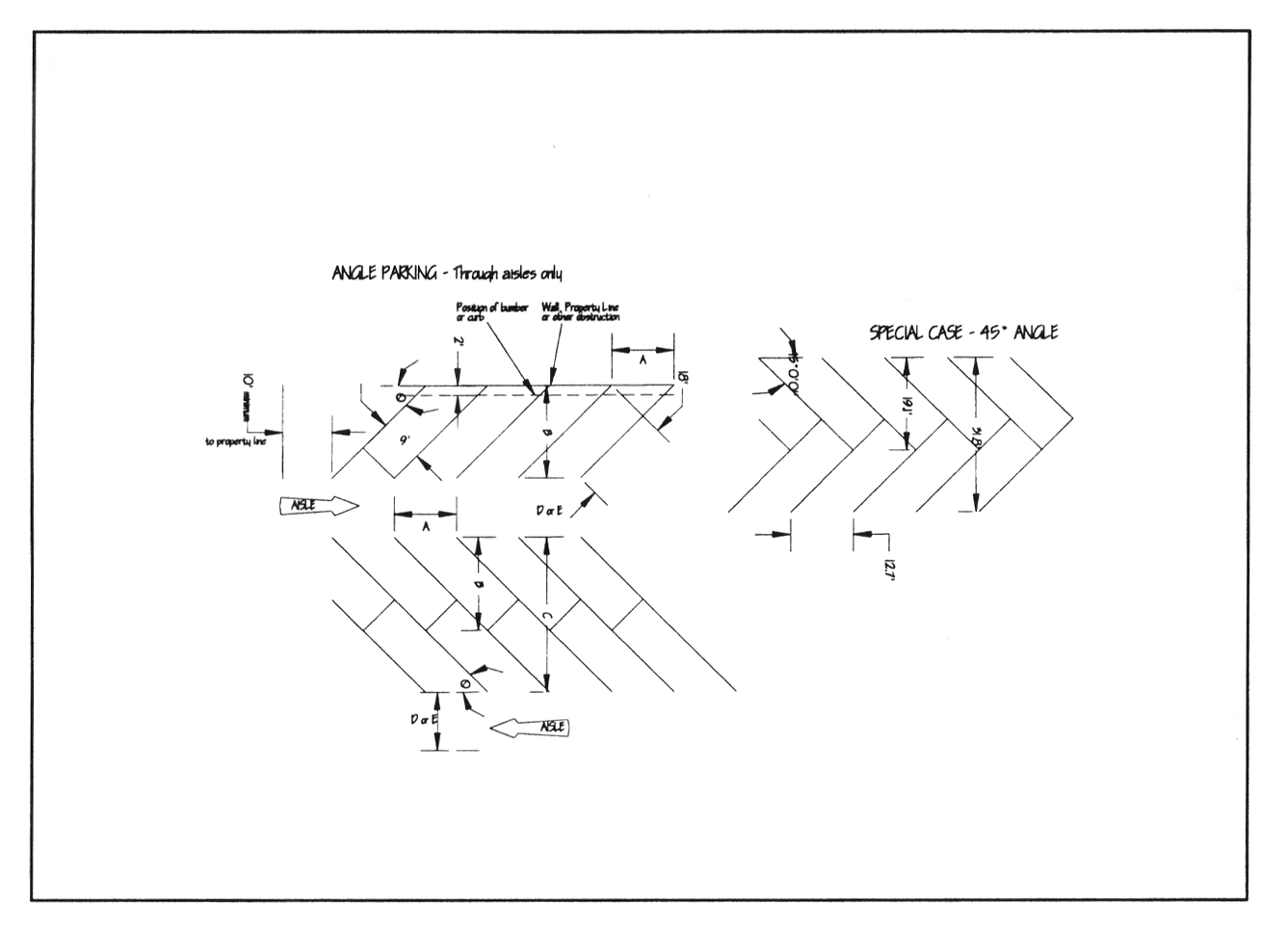
|
Basic Stall |
Back to Back |
Aisles |
|||
|---|---|---|---|---|---|
|
Angle – ° |
A |
B |
C |
D (One-Way) |
E (Two-Way) |
|
30° |
18 |
16.8 |
25.8 |
12 |
20 |
|
38° |
14.6 |
18.2 |
29.3 |
12 |
20 |
|
45° |
12.7 |
19.1 |
31.8 |
12 |
20 |
|
52° |
11.4 |
19.7 |
33.9 |
13 |
20 |
|
55° |
11 |
19.9 |
34.6 |
14 |
20 |
|
60° |
10.4 |
20.1 |
35.7 |
15 |
20 |
|
70° |
9.6 |
20 |
36.9 |
18 |
20 |
|
80° |
9.1 |
19.3 |
37 |
20 |
20 |
Diagram 2
Notes:
1. Bumpers must be installed where paved areas abut street right-of-way (except at driveways).
2. No stalls shall be such that cars must back over the property line to enter or leave stall.
3. Stalls must be clearly marked and the markings must be maintained in good condition.
4. The sketches show typical situations to illustrate the required standards. For further information or advice, contact the community development department at 537-1210.
|
Stall Width with Corresponding Aisle Width |
||||||
|---|---|---|---|---|---|---|
|
Stall Width = X |
9 |
9.5 |
10 |
10.5 |
11 |
12 |
|
Aisle Width = Y |
24 |
24 |
22 |
22 |
20 |
20 |
Diagram 3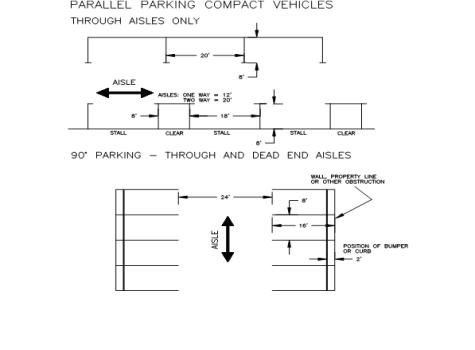
Notes:
1. Bumpers must be installed where paved areas abut street right-of-way (except at driveways).
2. No stalls shall be such that cars must back over the property line to enter or leave stall.
3. Stalls must be clearly marked and the markings must be maintained in good condition.
4. The sketches show typical situations to illustrate the required standards. For further information or advice, contact the planning department.
[Ord. 2933 § 1 (Exhs. A-1a, A-1b), 2-18-25; Ord. 2451, 12-2-96. Code 2001 § 151.616.]
15.440.075 Residential garage standards.
A. Single-car garages for residential uses shall have a minimum inside width of 10 feet by 20 feet.
B. Two-car garages for residential uses shall have a minimum inside width of 20 feet by 20 feet.
C. Three-car garages for residential uses shall have a minimum inside width of 30 feet by 20 feet. [Ord. 2880 § 2 (Exh. B § 49), 6-7-21.]
15.440.080 Off-street loading.
A. Buildings to be built or substantially altered which receive and distribute materials and merchandise by trucks shall provide and maintain off-street loading berths in sufficient number and size to adequately handle the needs of the particular use. Uses in the C-3 and M-5 districts may allow loading spaces to be in an alley or in on-street parking at the director’s discretion.
1. The following standards shall be used in establishing the minimum number of berths required:
|
Gross Floor Area of the Building in Square Feet |
No. of Berths |
|---|---|
|
Up to 10,000 |
1 |
|
10,000 and over |
2 |
2. A loading berth shall contain a space 10 feet wide and 35 feet long and have a vertical clearance of 14 feet. Where the vehicles generally used for loading and unloading exceed these dimensions, the required length of these berths shall be increased.
3. Additional off-street loading requirements within the C-4 district are described in NMC 15.352.040(H)(7).
4. Where a facility includes an aircraft hangar, the off-street loading requirement is not required since loading may occur through the hangar doors.
B. The following provisions shall apply to off-street loading facilities:
1. The provision and maintenance of off-street loading space is a continuing obligation of the property owner. No building permit shall be issued until plans are presented that show property that is and will remain available for exclusive use as off-street loading space. The subsequent use of property for which the building permit is issued shall be conditional upon the unqualified continuance and availability of the amount of loading space required by this code. Should the owner or occupant of any building change the use to which the building is put, thereby increasing off-street loading requirements, it shall be unlawful and a violation of this code to begin or maintain such altered use until such time as the increased off-street loading requirements are met.
2. Owners of two or more buildings may agree to utilize jointly the same loading spaces when the hours of operation do not overlap; provided, that satisfactory legal evidence is presented to the city attorney in the form of deeds, leases or contracts to establish the joint use.
3. A plan drawn to scale, indicating how the off-street loading requirements are to be fulfilled, shall accompany an application for a building permit.
4. Design Requirements for Loading Areas.
a. Areas used for standing and maneuvering of vehicles shall have durable and dustless surfaces of asphaltic concrete or portland cement concrete, maintained adequately for all-weather use and so drained as to avoid flow of water across the sidewalks.
b. Loading areas adjacent to residential zones designed to minimize disturbance of residents.
c. Artificial lighting which may be provided shall be so deflected as not to shine or create glare in any residential zone or on any adjacent dwelling.
d. Access aisles shall be of sufficient width for all vehicular turning and maneuvering.
e. Vision clearance standards as identified in NMC 15.410.060 shall apply. [Ord. 2930 § 4 (Exh. A-3), 1-6-25; Ord. 2647, 6-5-06; Ord. 2564, 4-15-02; Ord. 2451, 12-2-96. Code 2001 § 151.617.]
Penalty: See NMC 15.05.120.
Article II. Bicycle Parking
15.440.090 Purpose.
Cycling is a healthy activity for travel and recreation. In addition, by maximizing bicycle travel, the community can reduce negative effects of automobile travel, such as congestion and pollution. To maximize bicycle travel, developments must provide effective support facilities. At a minimum, developments need to provide a secure place for employees, customers, and residents to park their bicycles. [Ord. 2564, 4-15-02; Ord. 2518, 9-21-99. Code 2001 § 151.625.1.]
15.440.100 Facility requirements.
Bicycle parking facilities shall be provided for the uses shown in the following table. Fractional space requirements shall be rounded up to the next whole number.
|
Minimum Number of Bicycle Parking Spaces Required |
|
|---|---|
|
New multiple dwellings, including additions creating additional dwelling units |
One bicycle parking space for every four dwelling units |
|
New commercial, industrial, office, and institutional developments, including additions that total 4,000 square feet or more |
One bicycle parking space for every 10,000 square feet of gross floor area. In C-4 districts, two bicycle parking spaces, or one per 5,000 square feet of building area, must be provided, whichever is greater |
|
Transit centers and park and ride lots |
Four spaces or one per 10 vehicle spaces, whichever is greatera + b |
|
Two bicycle parking spaces within 50 feet of each developed play-ground, ball field, or shelter |
|
|
Two spacesa |
Notes:
a. Short-term bicycle parking is parking intended to be used for durations less than two hours. Short-term bicycle parking shall consist of a stationary rack or other approved structure to which the bicycle can be locked securely and shall be located within 50 feet of the main building entrance or one of several main entrances, and no further from an entrance than the closest automobile parking space. Shelter or cover may be required for a specified percentage of short-term parking.
b. Long-term bicycle parking is parking intended to be used for durations over two hours. Long-term parking shall consist of a lockable enclosure, a secure room in a building on-site, monitored parking, or another form of fully sheltered and secure parking.
[Ord. 2862 § 1 (Exh. A § 3), 6-15-20; Ord. 2564, 4-15-02; Ord. 2518, 9-21-99. Code 2001 § 151.625.2.]
15.440.110 Design.
A. Bicycle parking facilities shall consist of one or more of the following:
1. A firmly secured loop, bar, rack, or similar facility that accommodates locking the bicycle frame and both wheels using a cable or U-shaped lock.
2. An enclosed locker.
3. A designated area within the ground floor of a building, garage, or storage area. Such area shall be clearly designated for bicycle parking.
4. Other facility designs approved by the director.
B. All bicycle parking spaces shall be at least six feet long and two and one-half feet wide. Spaces shall not obstruct pedestrian travel.
C. All spaces shall be located within 50 feet of a building entrance of the development.
D. Required bicycle parking facilities may be located in the public right-of-way adjacent to a development subject to approval of the authority responsible for maintenance of that right-of-way. [Ord. 2518, 9-21-99. Code 2001 § 151.625.3.]
Article III. Private Walkways
15.440.120 Purpose.
Sidewalks and private walkways are part of the city’s transportation system. Requiring their construction is part of the city’s plan to encourage multimodal travel and to reduce reliance on the automobile. Considerable funds have and will be expended to install sidewalks along the streets in the city. Yet there is little point to this expense if it is not possible for people to walk from the sidewalk to the developments along each side. The following requirements are intended to provide safe and convenient paths for employees, customers, and residents to walk from public sidewalks to development entrances, and to walk between buildings on larger sites. [Ord. 2619, 5-16-05; Ord. 2513, 8-2-99. Code 2001 § 151.620.1.]
15.440.130 Where required.
Private walkways shall be constructed as part of any development requiring Type II design review, including mobile home parks. In addition, they may be required as part of conditional use permits or planned unit developments. In the airport industrial (AI) district and residential (AR) district, on-site walks are not required in aircraft operations areas, such as parking aprons, taxiways, and runways. [Ord. 2647, 6-5-06; Ord. 2619, 5-16-05; Ord. 2513, 8-2-99. Code 2001 § 151.620.2.]
15.440.140 Private walkway design.3
A. Required private walkways shall be a minimum of four feet wide.
B. Required private walkways shall be constructed of portland cement concrete or brick.
C. Crosswalks crossing service drives shall, at a minimum, be painted on the asphalt or clearly marked with contrasting paving materials or humps/raised crossings. If painted striping is used, it should consist of thermoplastic striping or similar type of durable application.
D. At a minimum, required private walkways shall connect each main pedestrian building entrance to each abutting public street and to each other.
E. The review body may require on-site walks to connect to development on adjoining sites.
F. The review body may modify these requirements where, in its opinion, the development provides adequate on-site pedestrian circulation, or where lot dimensions, existing building layout, or topography preclude compliance with these standards.
Editor’s note: Compliance with Americans With Disabilities Act requirements under applicable building codes, and engineering design and construction standards for public improvements, is also required.
[Ord. 2940 § 1 (Exhs. A-1a, A-1b), 11-17-25; Ord. 2619, 5-16-05; Ord. 2513, 8-2-99. Code 2001 § 151.620.3.]
City of Newberg follows all federal and state mandated ADA guidelines, see United States Access Board Public Right-of-Way Accessibility Guidelines below: https://www.access-board.gov/prowag/
Code reviser’s note: Ordinance 2730 sets out amendments to this section without accounting for prior amendments from Ordinance 2710. The code reflects the intended amendments of both ordinances.
City of Newberg follows all federal and state mandated ADA guidelines, see United States Access Board Public Right-of-Way Accessibility Guidelines below: https://www.access-board.gov/prowag/